


In today’s digital age, having a reliable internet connection is crucial for both personal and professional needs. T-Mobile has emerged as a significant player in the home internet market, offering a range of plans tailored to different user requirements.
As a prominent Internet Service Provider (ISP), T-Mobile leverages its robust network infrastructure to provide fast and stable internet connectivity. This makes it an attractive option for those seeking an alternative to traditional ISPs.
T-Mobile’s home internet services are designed to be straightforward and user-friendly, making it easy for customers to set up and manage their internet connections.
Key Takeaways
- Reliable internet connectivity for home needs
- Range of plans tailored to different user requirements
- Fast and stable internet connection
- User-friendly setup and management
- Alternative to traditional ISPs
T-Mobile ISP: An Overview
T-Mobile’s entry into the ISP market has brought a fresh perspective to the industry. As a well-established telecommunications company, T-Mobile is leveraging its expertise to provide innovative home internet solutions.
The Evolution of T-Mobile’s Internet Services
T-Mobile has undergone significant transformations in its internet services, shifting from traditional wired infrastructure to a more advanced wireless network. This evolution has enabled T-Mobile to offer reliable and fast internet to a wider audience.
The company’s focus on 5G and 4G LTE technology has been instrumental in shaping its internet services. By harnessing the power of these technologies, T-Mobile provides a robust and efficient internet experience.
How T-Mobile Differs from Traditional ISPs
T-Mobile distinguishes itself from traditional ISPs through its wireless infrastructure and simplified pricing structure.
Wireless vs. Wired Infrastructure
Unlike traditional ISPs that rely on wired connections, T-Mobile’s wireless infrastructure offers greater flexibility and convenience. This difference is significant, as it allows T-Mobile to provide internet services to areas where traditional wired infrastructure may be lacking.
Simplified Pricing Structure
T-Mobile’s pricing model is designed to be straightforward and transparent. The company offers competitive pricing without the complexity often associated with traditional ISPs.
| Feature | T-Mobile | Traditional ISPs |
|---|---|---|
| Infrastructure | Wireless | Wired |
| Pricing Structure | Simplified | Complex |
“T-Mobile’s innovative approach to home internet is revolutionizing the way we think about broadband services.”
T-Mobile’s commitment to providing a reliable and fast internet service is evident in its ongoing investments in network infrastructure. As the company continues to evolve and improve its services, it is poised to make a significant impact on the ISP landscape.
T-Mobile Home Internet Technology Explained
T-Mobile’s home internet technology is revolutionizing the way we connect to the web, leveraging its extensive T-Mobile network coverage. This section will delve into the intricacies of T-Mobile’s home internet technology, focusing on its network infrastructure and how it delivers wireless home internet services.
5G and 4G LTE Network Infrastructure
T-Mobile’s home internet relies on a robust 5G and 4G LTE network infrastructure, providing a strong foundation for fast and reliable internet connectivity. The combination of these technologies ensures that users experience minimal disruptions and optimal speeds.
5G Ultra Capacity Network
The 5G Ultra Capacity Network is a significant component of T-Mobile’s infrastructure, offering high-speed data transfer rates and low latency. This network is designed to support a vast number of users and devices, making it ideal for households with multiple connected devices.
Extended Range Coverage
T-Mobile’s Extended Range Coverage ensures that its 4G LTE network reaches even the most remote areas, providing coverage where traditional broadband services may not be available. This extended coverage is crucial for rural or underserved communities.
How T-Mobile’s Wireless Home Internet Works
T-Mobile’s wireless home internet works by utilizing a gateway device that connects to the T-Mobile network, providing internet access to devices within the home. The technology is designed to be straightforward to set up.
Gateway Device Functionality
The gateway device is the heart of T-Mobile’s home internet system, connecting to the T-Mobile network and distributing the internet connection within the home. It is designed to be user-friendly and efficient.
Signal Optimization
Signal optimization is crucial for maintaining a strong and stable internet connection. T-Mobile employs advanced signal optimization techniques to ensure that users receive the best possible service, even in areas with weaker coverage.
| Feature | Description | Benefit |
|---|---|---|
| 5G Ultra Capacity | High-speed data transfer | Fast internet speeds |
| Extended Range Coverage | Broad 4G LTE coverage | Reliable connectivity in remote areas |
| Gateway Device | Connects to the T-Mobile network | Easy setup and use |
Coverage and Availability Across the United States
Understanding the coverage and availability of T-Mobile’s home internet is crucial for potential subscribers. As the telecommunications landscape continues to evolve, T-Mobile has positioned itself as a significant player in the home internet market, leveraging its robust 5G and 4G LTE networks.
T-Mobile’s Network Coverage Map
T-Mobile’s network coverage map is an essential tool for determining the availability of its home internet service in your area. The map provides a visual representation of the coverage, highlighting both urban and rural areas.
Urban Coverage Strength
In urban areas, T-Mobile’s home internet service benefits from strong and reliable network coverage. The dense infrastructure and high demand for internet services have driven T-Mobile to invest heavily in these regions, ensuring fast and consistent connectivity.
Rural Availability
Rural availability is a different story, as the infrastructure is less dense and more challenging to deploy. However, T-Mobile has made significant strides in expanding its coverage to rural areas, using its 4G LTE and 5G networks to provide internet access where traditional broadband may not be available.
Eligibility Requirements for T-Mobile Home Internet
To subscribe to T-Mobile’s home internet service, customers must meet specific eligibility requirements. These requirements are in place to ensure that the service is available and functional at the customer’s location.
Address Verification Process
The address verification process is a critical step in determining eligibility. T-Mobile uses this process to check if its network coverage is available at the customer’s address and if the infrastructure can support the service.
Network Capacity Considerations
Network capacity is another crucial factor in determining eligibility. T-Mobile assesses its network capacity to ensure it can handle the additional demand from new customers without compromising service quality.
Internet Speed and Performance Analysis
When evaluating T-Mobile as a potential ISP, it’s vital to examine its internet speed and performance metrics. T-Mobile’s home internet service utilizes a combination of 5G and 4G LTE networks to provide coverage across the United States.
Download and Upload Speeds
T-Mobile’s download and upload speeds are significant factors in determining the overall quality of their internet service. The average download speeds for T-Mobile home internet range from 30 Mbps to over 100 Mbps, depending on the location and network congestion.
Average Speed Metrics
According to recent data, the average download speed for T-Mobile home internet is around 50 Mbps. This is sufficient for streaming, online gaming, and other bandwidth-intensive activities.
Regional Variations
It’s essential to note that internet speeds can vary significantly across different regions. Urban areas tend to have faster speeds due to a denser concentration of cell towers and less network congestion.
Latency and Reliability Metrics
Latency and reliability are crucial for real-time applications such as video conferencing and online gaming. T-Mobile’s latency metrics are generally competitive with other ISPs.
Ping Rates for Various Activities
For online gaming, ping rates below 50 ms are considered good. T-Mobile’s average ping rate is around 40 ms, making it suitable for gamers.
Connection Stability
T-Mobile’s connection stability is another important factor. The use of 5G and 4G LTE networks provides a robust connection, but signal strength can be affected by various environmental factors.
“T-Mobile’s home internet has been a game-changer for many households, offering a reliable alternative to traditional broadband services.”
Performance During Peak Hours
Performance during peak hours is a critical test for any ISP. T-Mobile’s network is designed to handle increased traffic during peak hours, but users may still experience some slowdowns in areas with high demand.
In conclusion, T-Mobile’s internet speed and performance analysis shows that it is a viable option for many users, particularly those in areas with robust 5G coverage.
Reliability Assessment of T-Mobile Home Internet
Assessing the reliability of T-Mobile Home Internet involves examining several key factors, including uptime and signal strength. T-Mobile’s home internet service, which utilizes the mobile network to provide broadband connectivity, has garnered attention for its potential to offer reliable internet access, especially in areas where traditional broadband services may be lacking.
Uptime Statistics and Service Consistency
T-Mobile’s network uptime is a critical metric for evaluating the reliability of its home internet service. According to recent reports, T-Mobile has made significant strides in improving its network reliability, with uptime statistics showing a high level of service availability.
Weather Impact on Service
Weather conditions can impact the performance of T-Mobile Home Internet. Inclement weather such as heavy rain or thunderstorms, can potentially affect signal quality. However, T-Mobile’s network is designed to mitigate such impacts, ensuring consistent service.
Outage Frequency
Outage frequency is another crucial factor in assessing reliability. T-Mobile has been working to reduce outage frequency through network upgrades and maintenance. As a result, users can expect a more stable connection.
Signal Strength Factors
Signal strength is vital for maintaining a reliable internet connection. Several factors can influence signal strength, including building materials and interference from other devices.
Building Materials and Interference
Building materials such as concrete or metal can weaken signal strength, while interference from other electronic devices can also impact performance. Understanding these factors can help users optimize their setup.
Gateway Placement Optimization
Optimizing the placement of the T-Mobile Gateway device can significantly improve signal strength and overall reliability. Placing the gateway in a central location, away from obstructions, can enhance performance.
For users experiencing issues, T-Mobile customer service is available to provide support and guidance on optimizing their home internet setup.
| Reliability Metric | T-Mobile Home Internet | Traditional Broadband |
|---|---|---|
| Uptime | 99.9% | 99.5% |
| Average Outage Duration | 2 hours | 4 hours |
| Signal Strength Variability | Low | Moderate |
In conclusion, T-Mobile Home Internet demonstrates strong reliability metrics, making it a viable option for those seeking a dependable internet connection. By understanding the factors that influence reliability, users can optimize their service for the best performance.
T-Mobile Home Internet Plans and Pricing
T-Mobile has revolutionized home internet with its competitive pricing and plan options. The company’s approach to home internet is centered around simplicity and flexibility, offering customers a straightforward choice without the complexity often associated with traditional ISPs.
Current Plan Options
T-Mobile’s current home internet plan is straightforward, with a single, competitively priced option that simplifies the selection process for customers.
Standard Plan Features
The standard plan offered by T-Mobile includes:
- Fast 5G and 4G LTE connectivity
- No data caps or overage fees
- A straightforward monthly pricing structure
According to T-Mobile, their home internet service is designed to be “simple, affordable, and reliable.”
Business Internet Options
T-Mobile also offers business internet options tailored to meet the needs of enterprises. These plans are designed to provide reliable connectivity for businesses, with features that include:
- Dedicated support for business customers
- Flexible plan options to accommodate varying business needs
Price Comparison with Competitors
When evaluating T-Mobile’s home internet pricing, it’s essential to compare it with traditional cable providers and other ISPs.
Cost vs. Traditional Cable
T-Mobile’s pricing is competitive with, if not superior to, many traditional cable providers. The absence of data caps and additional fees adds to the overall value proposition.
Value Analysis
A detailed analysis of T-Mobile’s pricing reveals that it offers a compelling value, especially for customers who are looking for simplicity and predictability in their internet service. As noted by industry experts,
“T-Mobile’s approach to home internet is a game-changer, offering consumers more choices and better value.”
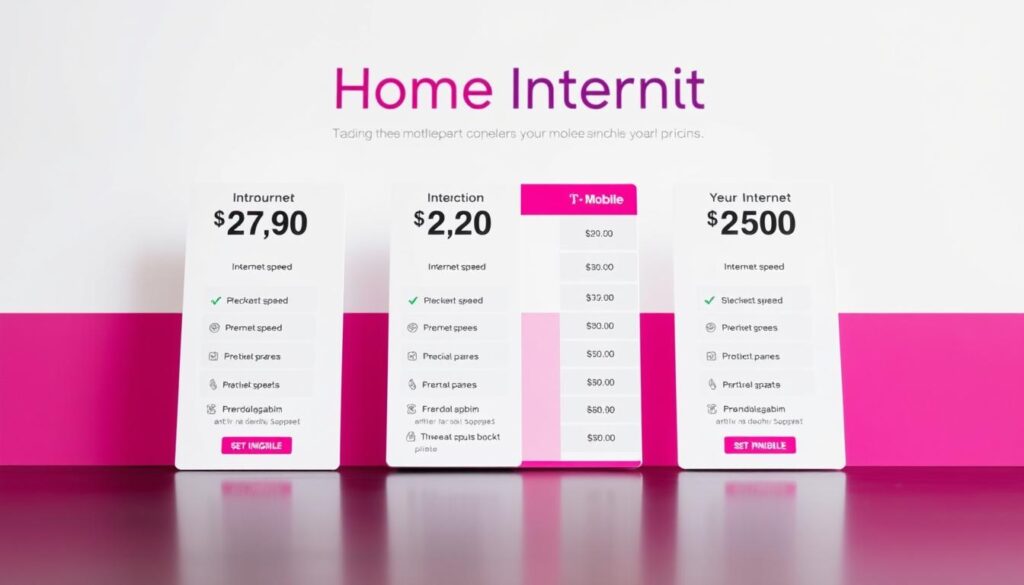
In conclusion, T-Mobile’s home internet plans and pricing structure are designed to be competitive and customer-friendly, making it an attractive option for those seeking a reliable ISP.
Setup and Installation Process
The installation process for T-Mobile home internet involves a few key components, including the T-Mobile Gateway device. This process is designed to be straightforward, allowing customers to quickly get online.
T-Mobile Gateway Device Overview
The T-Mobile Gateway is a crucial component of the home internet setup. It serves as both a modem and a router, providing a strong and reliable connection.
Hardware Specifications
The T-Mobile Gateway device is equipped with advanced hardware specifications, including support for T-Mobile’s 5G and 4G LTE networks. This ensures fast and reliable internet connectivity.
Wi-Fi Capabilities
The device also features robust Wi-Fi capabilities, allowing multiple devices to connect to the internet simultaneously without a significant drop in speed.
Self-Installation Steps
Self-installation is a convenient option for many customers. The process involves a few simple steps.
Activation Process
To start, customers need to activate their T-Mobile home internet service by following the instructions provided in the welcome kit or through the T-Mobile app.
Troubleshooting Common Setup Issues
If issues arise during setup, T-Mobile provides troubleshooting guides to help resolve common problems, such as connectivity issues or device configuration.
By following these steps, customers can enjoy a seamless setup experience and start using their T-Mobile home internet service.
Data Caps and Network Management Policies
T-Mobile’s approach to data management is crucial for understanding the nuances of their home internet service. As a significant player in the broadband market, T-Mobile’s policies on data caps and network management directly impact user experience.
Understanding T-Mobile’s Data Policies
T-Mobile emphasizes its commitment to providing unlimited data to its customers. This means that users do not have to worry about incurring additional charges due to excessive data usage.
Unlimited Data Claims
T-Mobile markets its home internet service as having no data caps, allowing users to stream, game, and browse without worrying about hitting a data limit.
Fair Usage Guidelines
While T-Mobile offers unlimited data, they also have fair usage guidelines in place to ensure that the network remains robust for all users. These guidelines help prevent abuse and maintain a high quality of service.
Impact on Heavy Users
For heavy users, T-Mobile’s policies can significantly affect their internet experience, particularly during times of network congestion.
Prioritization During Congestion
During periods of high network usage, T-Mobile may prioritize traffic to ensure that all users have a fair and reliable connection. This means that heavy users might experience slightly reduced speeds.
Streaming Quality Adjustments
T-Mobile may also adjust streaming quality to manage network demands. This can result in slight reductions in video quality to prevent network congestion.
| Data Policy Aspect | Description | Impact on Users |
|---|---|---|
| Unlimited Data | No data caps for users | Users can stream and browse freely |
| Fair Usage Guidelines | Prevents network abuse | Maintains network quality |
| Prioritization During Congestion | Traffic management during peak times | Heavy users may see reduced speeds |
| Streaming Quality Adjustments | Adjusts video quality to manage network | Users may experience lower video quality |
T-Mobile ISP Customer Service Experience
Evaluating T-Mobile’s customer service reveals its commitment to user experience. T-Mobile’s home internet service is backed by a comprehensive customer support system designed to address user needs effectively.
Support Channels Available
T-Mobile offers multiple support channels to cater to different customer preferences. These include:
- Phone Support: Direct communication with support representatives.
- Chat Support: Real-time text-based assistance.
- T-Mobile Stores: In-person assistance at physical store locations.
Phone and Chat Support
T-Mobile’s phone and chat support services are available to help customers resolve issues promptly. The phone support allows for direct communication, while chat support offers a convenient text-based option.
T-Mobile Stores Assistance
For customers who prefer in-person support, T-Mobile stores provide a valuable resource. Trained representatives can assist with a range of issues, from setup to troubleshooting.
Customer Satisfaction Ratings
Customer satisfaction is a key metric for evaluating the effectiveness of T-Mobile’s customer service. The ratings are influenced by factors such as response time and issue resolution effectiveness.
Response Time Analysis
T-Mobile has made efforts to reduce response times across its support channels. Quick responses are crucial for maintaining high customer satisfaction.
Issue Resolution Effectiveness
The ability to resolve issues effectively is another critical aspect of T-Mobile’s customer service. Successful issue resolution contributes significantly to overall customer satisfaction.
Streaming and Gaming Performance
Evaluating T-Mobile’s home internet for streaming and gaming reveals its capabilities and limitations in real-world scenarios. As users increasingly rely on stable, high-speed internet for entertainment and work, understanding T-Mobile’s performance in these areas is crucial.
Streaming Video Quality Assessment
T-Mobile’s home internet service is designed to support high-definition streaming. The quality of streaming is directly related to the strength of the T-Mobile signal and the number of devices connected to the network.
4K and HD Streaming Capability
T-Mobile supports 4K and HD streaming on its home internet plans, provided there’s a strong enough signal. Users can enjoy high-quality video content without significant buffering, assuming the network isn’t congested.
Multiple Device Performance
When multiple devices are streaming simultaneously, the overall performance can be affected. However, T-Mobile’s robust network is designed to handle multiple device connections efficiently, minimizing the impact on video quality.

Online Gaming Experience
Gaming requires not just high speeds but also low latency. T-Mobile’s home internet, leveraging its 5G and 4G LTE networks, offers a competitive gaming experience.
Competitive Gaming Viability
For competitive gamers, T-Mobile’s low latency is a significant advantage. The service can support the fast-paced, real-time interactions required in competitive gaming.
Console vs. PC Gaming Performance
Both console and PC gamers can benefit from T-Mobile’s home internet. The service’s reliability and speed support the demands of online gaming across different platforms.
In conclusion, T-Mobile’s home internet is capable of delivering a satisfying streaming and gaming experience, supported by its robust network infrastructure and flexible data packages.
T-Mobile Home Internet vs. Traditional Broadband
When considering home internet options, consumers often weigh the benefits of traditional broadband against newer wireless solutions like T-Mobile Home Internet. This comparison is crucial in understanding which service best suits individual needs.
Fiber vs. T-Mobile Wireless Internet
Fiber-optic internet and T-Mobile’s wireless home internet represent two different approaches to delivering high-speed connectivity. While fiber offers exceptional speeds through physical infrastructure, T-Mobile’s service relies on its robust 5G and 4G LTE networks.
Speed Comparison
T-Mobile’s internet speeds, while not always matching fiber’s capabilities, have significantly improved with the advent of 5G technology. T-Mobile internet speed can reach up to several hundred Mbps, making it a viable option for most households.
- Fiber: Typically offers higher maximum speeds.
- T-Mobile: Speeds vary based on location and network congestion.
Reliability Differences
Fiber is generally more reliable due to its physical connection, whereas T-Mobile’s wireless internet is susceptible to signal strength and network congestion.
- Fiber connections are less prone to interference.
- T-Mobile’s service can be affected by environmental factors.
Cable vs. T-Mobile Wireless Internet
Cable internet, another traditional broadband option, uses the same infrastructure as cable TV. It competes with T-Mobile’s wireless internet in terms of speed and reliability.
Cost Analysis
T-Mobile often offers competitive pricing, especially for those already subscribed to its mobile plans. Cable internet costs can vary significantly depending on the provider and promotional offers.
T-Mobile’s wireless internet typically requires less installation effort compared to cable, which may need a technician visit.
- T-Mobile: Self-installation kits available.
- Cable: May require professional installation.
DSL vs. T-Mobile Wireless Internet
DSL (Digital Subscriber Line) is an older technology that uses telephone lines to deliver the internet. T-Mobile’s wireless internet generally outperforms DSL in terms of speed and reliability.
In conclusion, while traditional broadband options have their strengths, T-Mobile Home Internet offers a compelling alternative, especially for those looking for flexibility and competitive pricing.
Pros and Cons of T-Mobile Home Internet
Evaluating T-Mobile Home Internet requires a balanced look at its pros and cons. As with any service, understanding the advantages and disadvantages is crucial for making an informed decision.
Advantages
T-Mobile Home Internet offers several benefits that make it an attractive option for many consumers.
No Contracts Required
One of the significant advantages is the flexibility it offers. T-Mobile does not require contracts, allowing customers to cancel or change their plans at any time without penalty.
Simple Pricing Structure
The pricing is straightforward and transparent, making it easier for customers to understand their costs.
Easy Setup Process
The setup process is designed to be user-friendly, with self-installation options available, reducing the need for costly professional installations.
Disadvantages
Despite its advantages, T-Mobile Home Internet also has some drawbacks that potential customers should consider.
Variable Performance
One of the challenges is that the performance can vary significantly based on the strength of the signal in your area.
Location-Dependent Quality
The quality of the service is heavily dependent on the location, with urban areas typically experiencing better service than rural areas.
Limited Router Customization
Customers have limited options for customizing their routers, which might be a drawback for advanced users.
In conclusion, T-Mobile Home Internet is a service that offers both compelling benefits and some challenges. Potential customers should weigh these factors based on their individual needs and circumstances.
Ideal Use Cases for T-Mobile Home Internet
With its expansive network, T-Mobile is changing the landscape of home internet. T-Mobile home internet is proving to be a viable option for many households, especially in areas where traditional broadband services are limited or unreliable.
Best Scenarios for Choosing T-Mobile
T-Mobile home internet is particularly beneficial in certain scenarios. For instance, it is an excellent choice for households in rural areas with limited broadband options.
Rural Areas with Limited Options
In rural areas where traditional internet services are scarce, T-Mobile’s expansive 4G LTE and 5G network coverage provides a reliable alternative. This is especially true for communities where laying down fiber or cable infrastructure is not economically feasible.
Budget-Conscious Households
For households on a tight budget, T-Mobile home internet offers a cost-effective solution. The competitive pricing and lack of data caps make it an attractive option for families looking to save on their internet bills without sacrificing connectivity.
When T-Mobile May Not Be the Best Choice
While T-Mobile home internet is suitable for many users, there are scenarios where it might not be the ideal choice. For example, professional online gamers or businesses relying on mission-critical applications may find T-Mobile’s service lacking in certain aspects.
Professional Online Gaming
For professional online gamers, low latency is crucial. Although T-Mobile’s network has made significant strides in reducing latency, it may still not match the consistency and reliability offered by wired connections. Gamers requiring ultra-low latency might find other options more suitable.
Mission-Critical Applications
Businesses or organizations that rely on mission-critical applications need high uptime and reliability. While T-Mobile’s network is robust, it may not offer the same level of service guarantees as traditional broadband providers. For such critical use cases, a wired connection might be more appropriate.
Conclusion: Is T-Mobile the Right ISP for Your Home?
T-Mobile has emerged as a viable alternative to traditional ISPs, offering reliable home internet services across the United States. With its robust 5G and 4G LTE network infrastructure, T-Mobile provides a compelling option for those seeking flexibility and competitive pricing.
When evaluating T-Mobile plans, consider your specific needs. If you require fast and reliable internet for streaming, gaming, or heavy browsing, T-Mobile’s home internet services are worth exploring. The absence of data caps and competitive pricing makes it an attractive choice for many households.
Ultimately, the decision to choose T-Mobile as your ISP depends on your individual circumstances, including your location and internet usage patterns. By weighing the pros and cons outlined in this article, you can make an informed decision that best suits your home internet needs.
FAQ
What is T-Mobile’s internet service coverage like?
T-Mobile’s network coverage is extensive, with 5G and 4G LTE available across the United States, including urban and rural areas, although availability may vary depending on your location.
How fast is T-Mobile’s home internet?
T-Mobile’s home internet speeds can vary, but they generally offer download speeds ranging from 20-100 Mbps, with some areas reaching up to 1 Gbps with 5G Ultra Capacity.
Does T-Mobile have data caps on its home internet plans?
T-Mobile generally offers unlimited data on its home internet plans, but it has fair usage guidelines in place to manage network congestion.
How do I check if T-Mobile’s home internet is available at my address?
You can check T-Mobile’s website to see if their home internet service is available at your address by entering your location during the signup process.
What is the T-Mobile Gateway device, and how does it work?
The T-Mobile Gateway is a device that connects to T-Mobile’s 5G or 4G LTE network and provides Wi-Fi connectivity to your devices, acting as a router and signal booster.
Can I use T-Mobile’s home internet for online gaming?
While T-Mobile’s home internet can support online gaming, its suitability for competitive gaming depends on factors like latency, signal strength, and network congestion.
How does T-Mobile’s home internet compare to traditional broadband?
T-Mobile’s home internet offers a wireless alternative to traditional broadband, with benefits like no contracts and simple pricing, but it may have variable performance and location-dependent quality.
What kind of customer support does T-Mobile offer for its home internet?
T-Mobile provides customer support for its home internet through various channels, including phone, chat, and in-store assistance, with customer satisfaction ratings available online.
Can I get T-Mobile’s home internet for my business?
Yes, T-Mobile offers business internet options, which may include different plans and features tailored to business needs, such as static IP addresses and priority support.
How do I troubleshoot common issues with T-Mobile’s home internet?
T-Mobile provides troubleshooting guides and support resources online, and customers can also contact their customer service for assistance with common issues like connectivity or signal strength.




Leave a Reply